
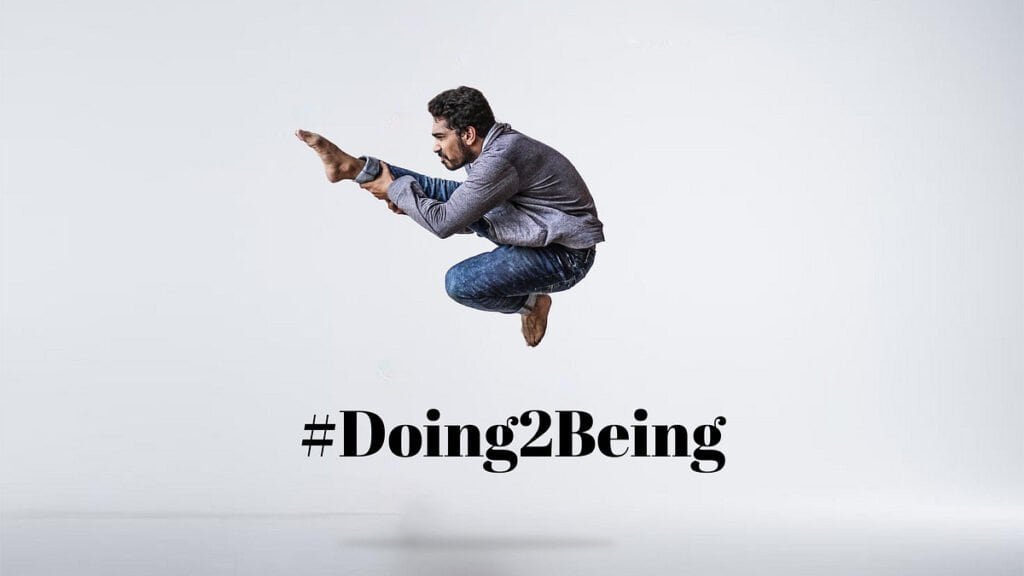
For most of my professional life, I believed leadership was about performance.
This belief was shaped early in the village and primary school, then in cantonments, hostels, and campuses. The corporate world reinforced it over more than two decades of P&L responsibility.
Performance meant results.
- Targets to achieve
- Visibility to gain
- Growth to sustain
- Recognition to justify all the above
- Control — unknowingly, at first
To be fair, performance matters. Organisations are built on it. Careers are measured by it. Entire identities are shaped by it. I was always aware that my self-identity rested heavily on my professional work. That was true then. In some ways, it still is.
Coaching — A Calling, A Blessing
I spent over two decades in corporate leadership before moving into executive coaching. Like many professionals, I learned how to manage pressure, solve problems, and keep moving. I became good at doing.
What I did not realize then was this: most successful professionals spend their entire lives learning how to perform, but never truly learn how to be. That distinction, when it finally arrived, changed everything for me.
The Invisible Exhaustion of High Performance
Most high achievers are not struggling because they are incapable. They are struggling because they have become over-identified with performance.
When performance becomes identity:
- Rest feels like guilt. My music class (a hobby) feels guilty too.
- Silence feels unproductive.
- Uncertainty feels threatening.
- Relationships become transactional.
- Listening becomes waiting for your turn to speak.
Externally, life may still look successful. Internally, something begins to thin out. We live in a social media era, after all. What thins out is meaning. Presence. Joy. Connection. Awareness.
Over time, many leaders unconsciously start living in a permanent state of mental projection — the next target, the next quarter, the next role, the next achievement. And happiness is always tied to them.
The mind becomes highly active. The self slowly disappears.
The Day I Started Seeing Leadership Differently
My shift did not come from a corporate workshop or a management framework. It emerged gradually — through hundreds of coaching conversations with founders, CXOs, senior leaders, and aspiring coaches.
I began noticing something fascinating. The deepest breakthroughs rarely came from advice. They came from awareness.
A leader would arrive wanting help with strategy, conflict, or career decisions. But beneath the visible issue was often a deeper, quieter question:
Who am I becoming while pursuing all this?
That question changes the quality of the conversation entirely. A coaching conversation at its best is not merely problem-solving. It is a mirror — not a mirror for performance, but a mirror for consciousness.
Presence Is Becoming a Leadership Advantage
Throughout my banking career, we had a running joke: “Common sense is most uncommon.”
We are now entering an age where intelligence itself is becoming abundant. Artificial intelligence can summarise faster, analyse better, optimise quicker. But something important is becoming clearer in parallel.
The future may belong less to those who only process information and more to those who can process humanity.
The ability to hold complexity without panic. The ability to listen without immediately reacting. These qualities are difficult to automate because they are deeply human. Ironically, the more technology advances, the more valuable human consciousness may become.
The question is no longer: “How do we compete with AI?”
Perhaps the more important question is: “How do we become more deeply human?”
From Doing to Being
One of the most misunderstood ideas in leadership development is the assumption that growth is primarily external.
More skills. More tools. More frameworks. More certifications.
But some shifts cannot be manufactured through accumulation. They emerge through reflection. Through self-observation. Through learning to sit with discomfort without immediately escaping it. Through becoming less performative and more authentic.
In coaching, I often describe this as the shift from Doing → Being → Doing.
The first doing is effort-driven. The second doing emerges from awareness. Externally, the action may look similar. Internally, the state is completely different. One is driven by anxiety and the need for validation. The other is grounded in clarity and presence.
This shift is subtle. But once experienced, it becomes impossible to ignore.
Why Most Professionals Never Make This Shift
Because the world rewards performance much earlier than presence.
Performance gets promoted. Presence gets noticed slowly. Performance is measurable. Presence is experiential. Performance creates visibility. Presence creates depth.
And yet, if you observe leaders who leave a lasting impact on people, teams, and culture — it is rarely their efficiency alone that people remember.
“People remember how they made others feel.” — attributed to Gautama Buddha.
They remember whether they felt seen. Whether they felt heard. Whether trust was created around them.
Leadership, in the end, is not merely about output. It is about the quality of consciousness we bring into human interaction.
A Personal Reflection
Even today, I still find myself slipping into performance mode. The conditioning runs deep.
The desire to appear capable. The urge to have answers. The temptation to optimise every moment.
But coaching, spirituality, reflective practice — and life itself — continue to remind me of something simpler:
Presence is not passivity.
Presence is full engagement with reality, without constantly needing to control it.
Perhaps real leadership begins there. Not when we finally become extraordinary performers. But when we become deeply available human beings.
Human Doing vs. Human Being — it is, ultimately, a choice.